

Key points
- It is already here, in Europe too: since August 24, 2026, ChatGPT has been showing ads to Free and Go users in 31 European countries, Italy included. By October the count had reached 89 markets.
- It is not just OpenAI: Google is taking AI Mode and AI Overviews ads worldwide, and Bing shows them inside its AI-generated summaries. Anthropic, by contrast, has said Claude will stay ad-free.
- Data is the sensitive point: the current conversation always shapes the ads, and advertisers can match their own lists of emails and phone numbers. European rules have not yet been tested on this ground.
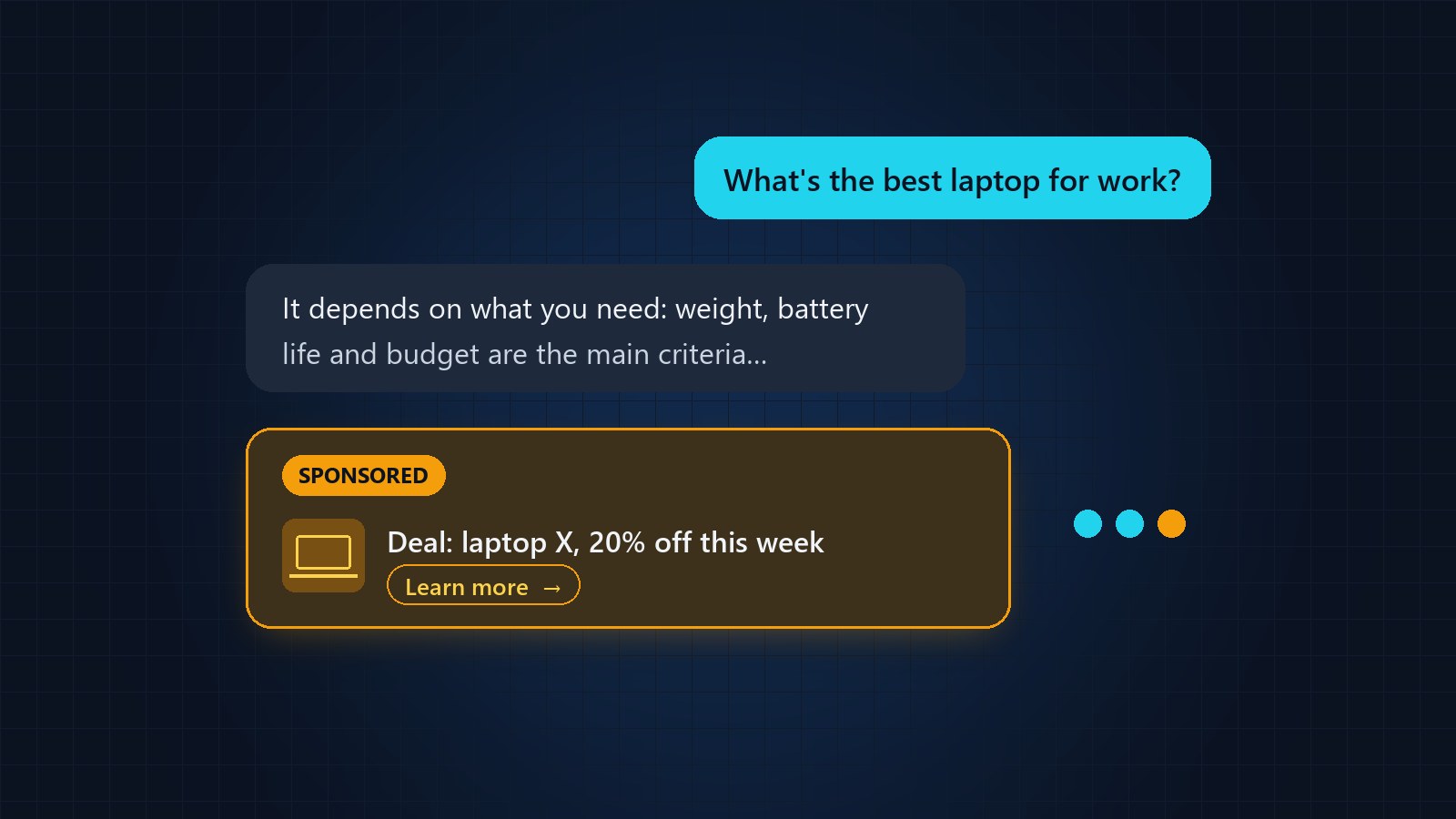
For years the question was: “how will chatbots make money?”. In 2026 the answer arrived, and it is the oldest one on the web: advertising. In less than a year, ads went from tests in the United States to the conversations of millions of European users. Here is what we know, what we do not know yet, and why this is different from the banners we are used to.
Eight months to reach Europe
OpenAI announced its advertising principles in January 2026 and started its first tests in the United States early in the year. From the week of August 24, ads reached 31 European markets: the 27 EU member states plus Norway, Iceland, Liechtenstein and Switzerland. On October 21 OpenAI announced an extension to 26 more countries, for a total of 89, and said more than 100,000 advertisers had already used the platform.
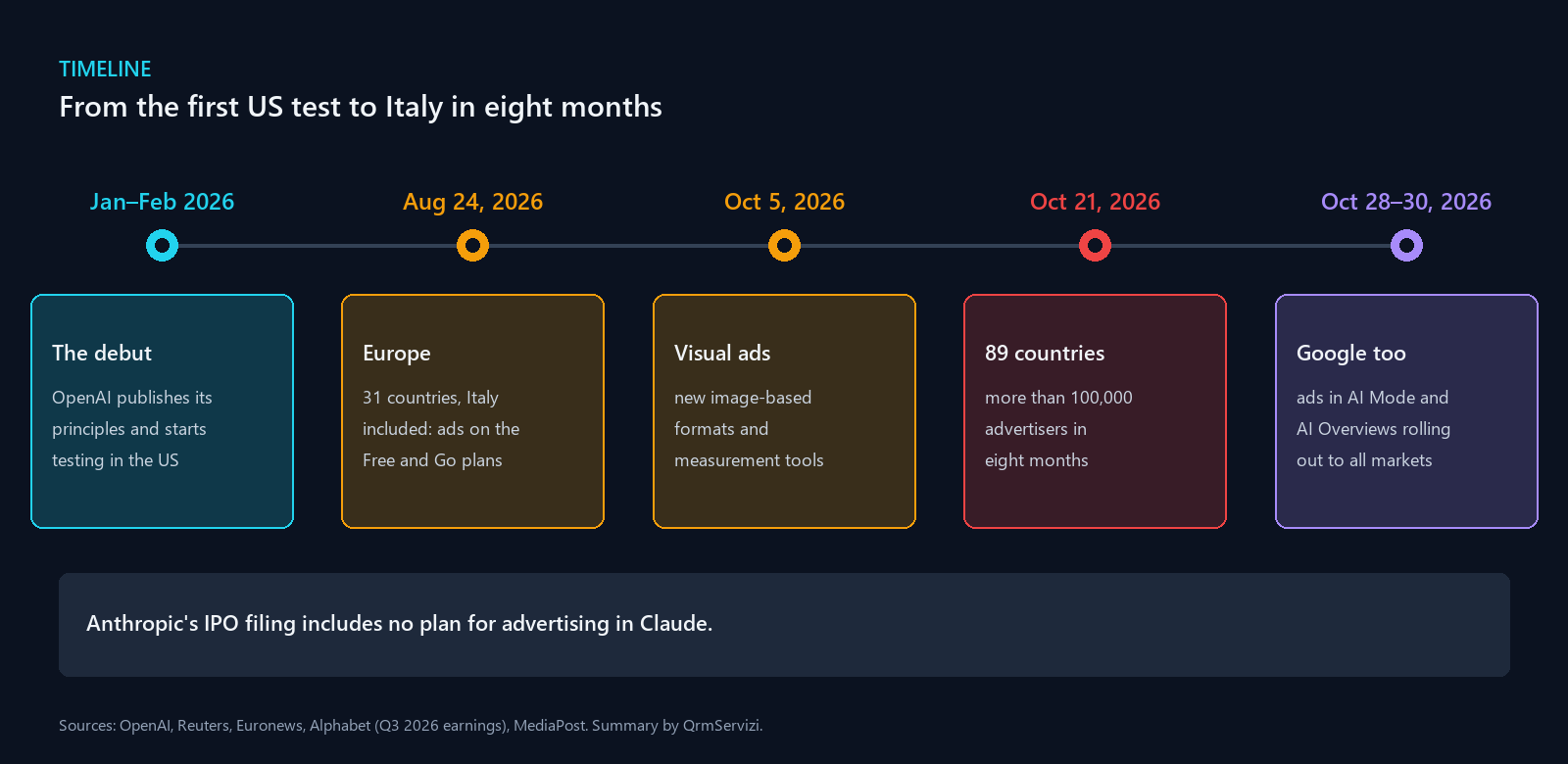
Ads appear only on the Free and Go plans ($8 a month). Plus, Pro, Business, Enterprise and Edu remain ad-free. According to OpenAI, ads are “clearly labeled and separated from the answers”, do not influence what ChatGPT says, and are not shown to users under 18 or next to topics such as health, mental health and politics. In October visual formats arrived as well, including ads next to generated images.
How the ad you see is chosen
The mechanism is the heart of the matter. According to OpenAI’s documentation, as reconstructed by 404 Media in October, four signals decide which ad appears:
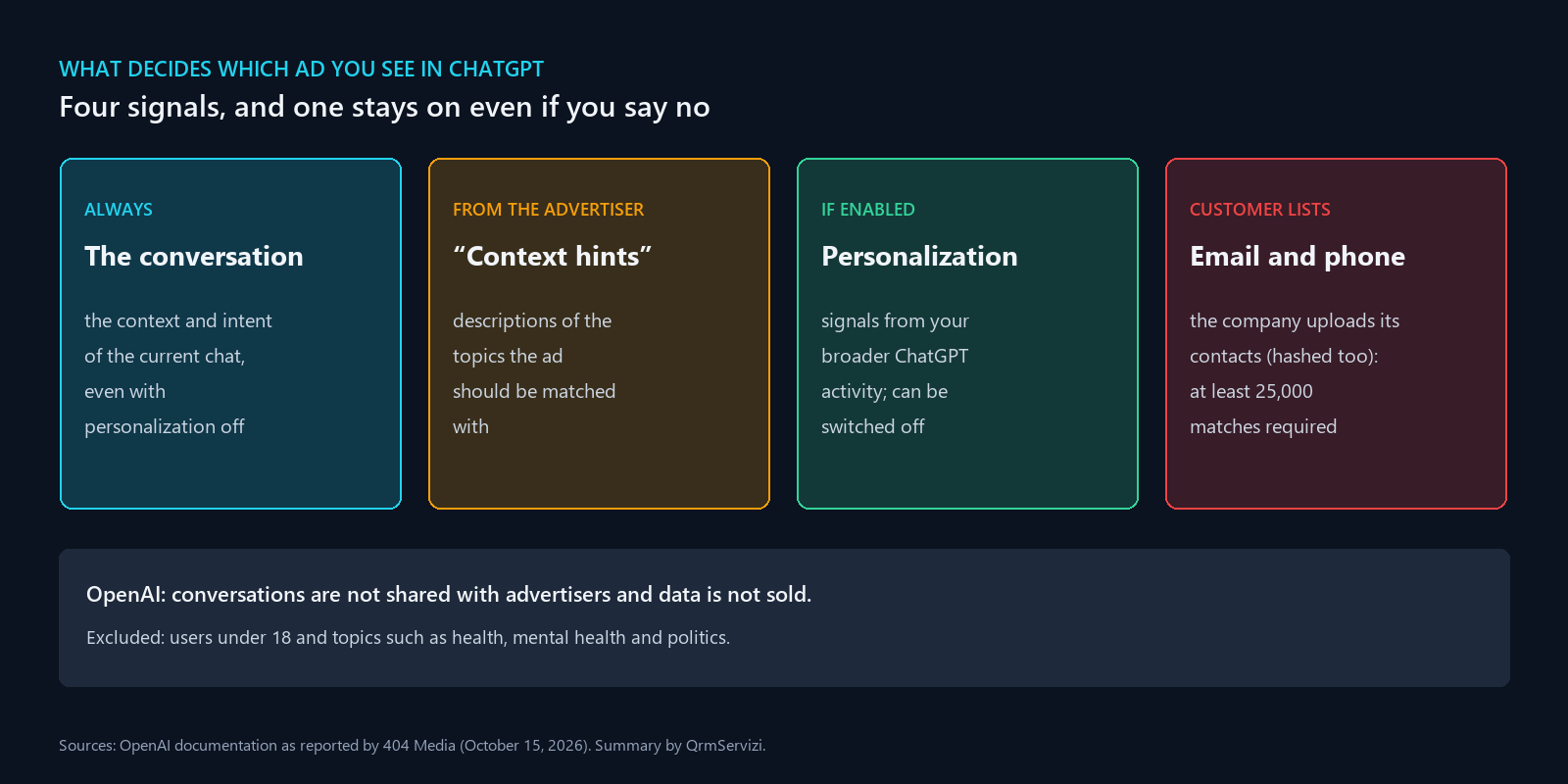
Two aspects deserve attention. First: even users who turn off personalization keep seeing ads based on the current conversation. Second: advertisers can upload their own customer lists, with emails and phone numbers, hashed or not, to reach those people on ChatGPT. At least 25,000 matches are required and, according to OpenAI, the company cannot tell which people on its lists were matched. Conversations, OpenAI says, are not shared with advertisers and data is not sold.
Not just ChatGPT
The race is industry-wide. Presenting its third-quarter results at the end of October, Google admitted that the growth of AI Mode searches had slowed revenue, because those answers earn less than traditional ads. The fix it announced is to take AI Mode and AI Overviews ads “global for the first time” and, in the United States, into follow-up questions too. Bing already shows ads inside its AI-generated summaries.
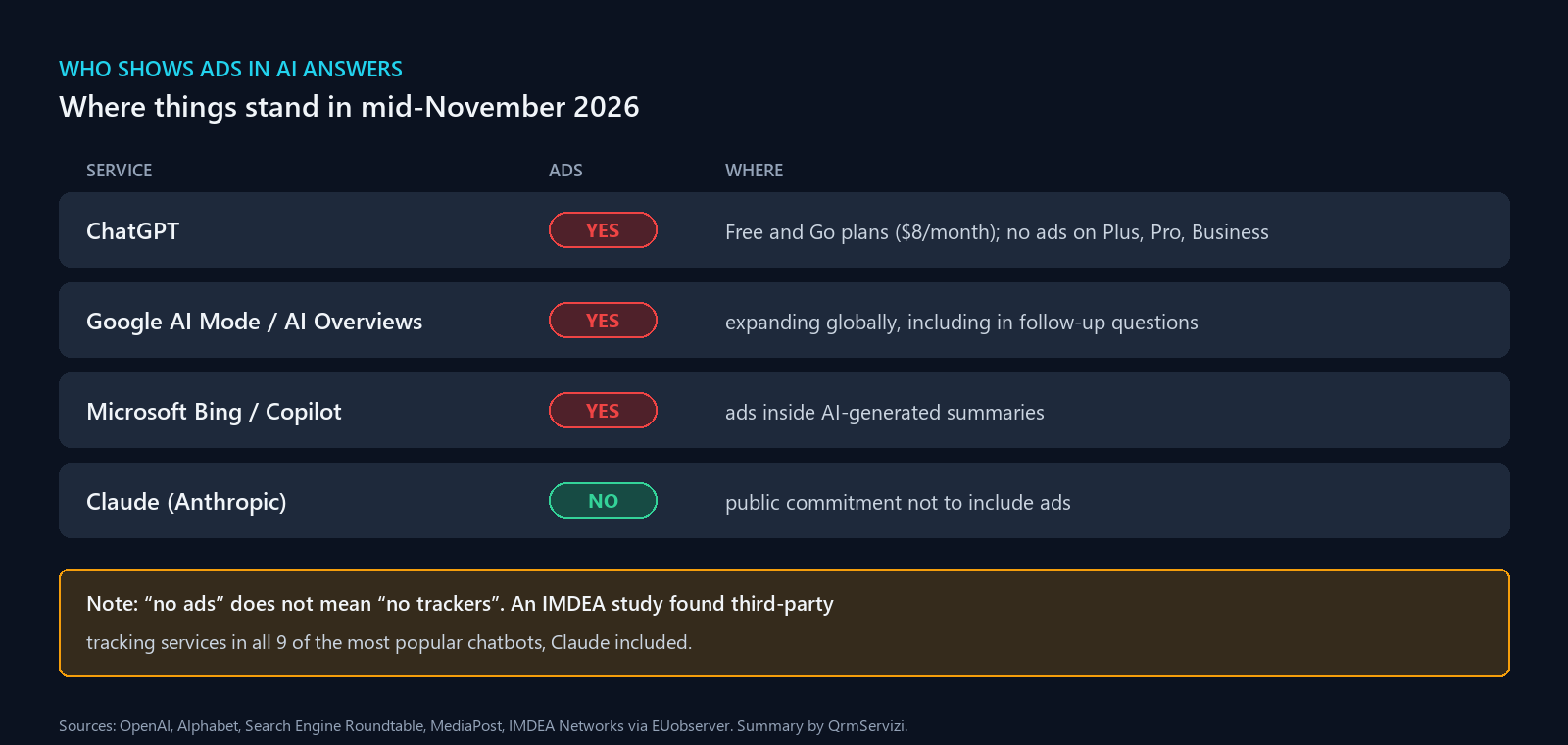
Anthropic is going the other way. In February it publicly committed not to put advertising in Claude, and the prospectus it filed in October for its stock market listing contains no plan for advertising revenue: the model remains subscriptions and enterprise contracts.
But “no ads” should not be confused with “no tracking”. A study by the Madrid-based institute IMDEA Networks, published at the end of September, analyzed the nine most popular chatbots: all of them integrated at least one third-party tracking or advertising service, and six out of nine exposed part of what users typed to third parties. Six of them, Claude included, connected to Google Ads even after non-essential cookies had been rejected. The Spanish data protection authority asked for the findings to be shared with its European counterparts.
Why an ad in a chat is not a banner
On a search engine we see ten results, compare them and skip the sponsored ones. In a conversation we get one answer, often in a friendly, personal tone, and the line between advice and promotion is much finer. We discussed this when writing about assistants that tell us what to buy: fewer intermediate steps also mean fewer opportunities to check.
Then there is the nature of the data. We tell chatbots about our doubts at work, our health, our finances: information far more intimate than the keywords we type into a search engine. OpenAI’s stated exclusions for health and politics point in the right direction, but their effectiveness can only be judged through independent checks.
European rules: plenty of laws, no precedents
Europe is not starting from scratch, but none of its rules was written with ads inside an AI conversation in mind:
- AI Act: it prohibits systems that use subliminal or deliberately manipulative techniques. Where commercial persuasion ends and manipulation begins, however, no authority or court has yet clarified for chatbots.
- Digital Services Act: the Commission is assessing whether ChatGPT’s search feature exceeds the threshold of 45 million monthly users in the EU that triggers the obligations for “very large online search engines”: risk assessments, independent audits and a public ad repository.
- GDPR and the ePrivacy Directive: profiling needs a clear legal basis, and non-essential trackers need consent. The IMDEA study suggests that this problem already affects almost every chatbot, with or without ads.
- Unfair commercial practices: advertising must be recognizable as such. It is the same principle Italy’s AGCOM applies to influencers, and it will become central if ads are increasingly woven into answers.
What to do now
For chatbot users:
- check the ad personalization settings and, if you prefer, turn personalization off;
- treat purchase advice received in a chat the way you would treat a salesperson’s: useful, but to be checked;
- avoid sharing sensitive data on free plans, and consider a paid plan if the chatbot is a work tool.
For businesses:
- marketing teams have a new channel to test, but must make sure that uploading customer lists is covered by an adequate legal basis under the GDPR;
- companies rolling out chatbots to employees should use business versions, ad-free and with contractual guarantees on data;
- anyone embedding a chatbot in their website should check which third-party trackers it loads, before a regulator does.
The compass
Advertising can make AI accessible to everyone, but an assistant that gives a single answer carries more responsibility than a search engine. The question is not whether chatbots will have ads: they already do. It is whether we will always be able to recognize them.
Transparency: this article was prepared with the assistance of Claude, the model developed by Anthropic, one of the companies mentioned. Information current as of mid-November 2026.
Sources
- Euronews: ChatGPT introduces advertising in Europe (August 2026, in Italian)
- 01net: ChatGPT Ads reaches Italy and 30 other European markets (in Italian)
- Reuters: OpenAI expands ChatGPT ads to 26 more countries (October 2026)
- Unite.AI: ChatGPT Ads in 89 countries, plans and rules
- GadgetReview on 404 Media: how ChatGPT targets ads
- MediaNama: Google to put more ads in AI Mode (October 2026)
- MediaPost: Anthropic IPO omits any plans for an ad model
- EUobserver: the IMDEA Networks study on trackers in chatbots
- WIRED: Ads in Chatbots Have Arrived (November 2026)


Leave a Reply