

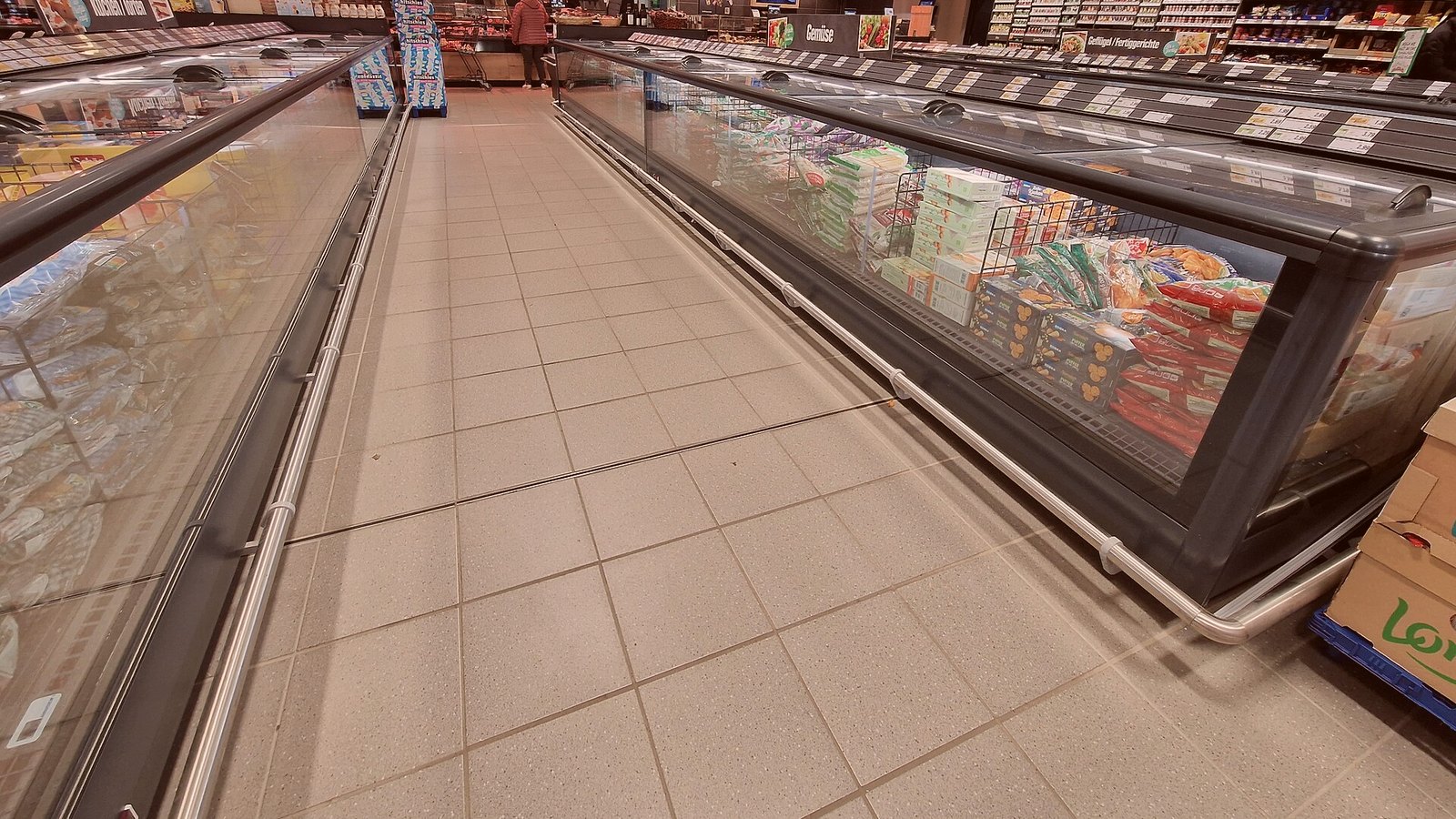
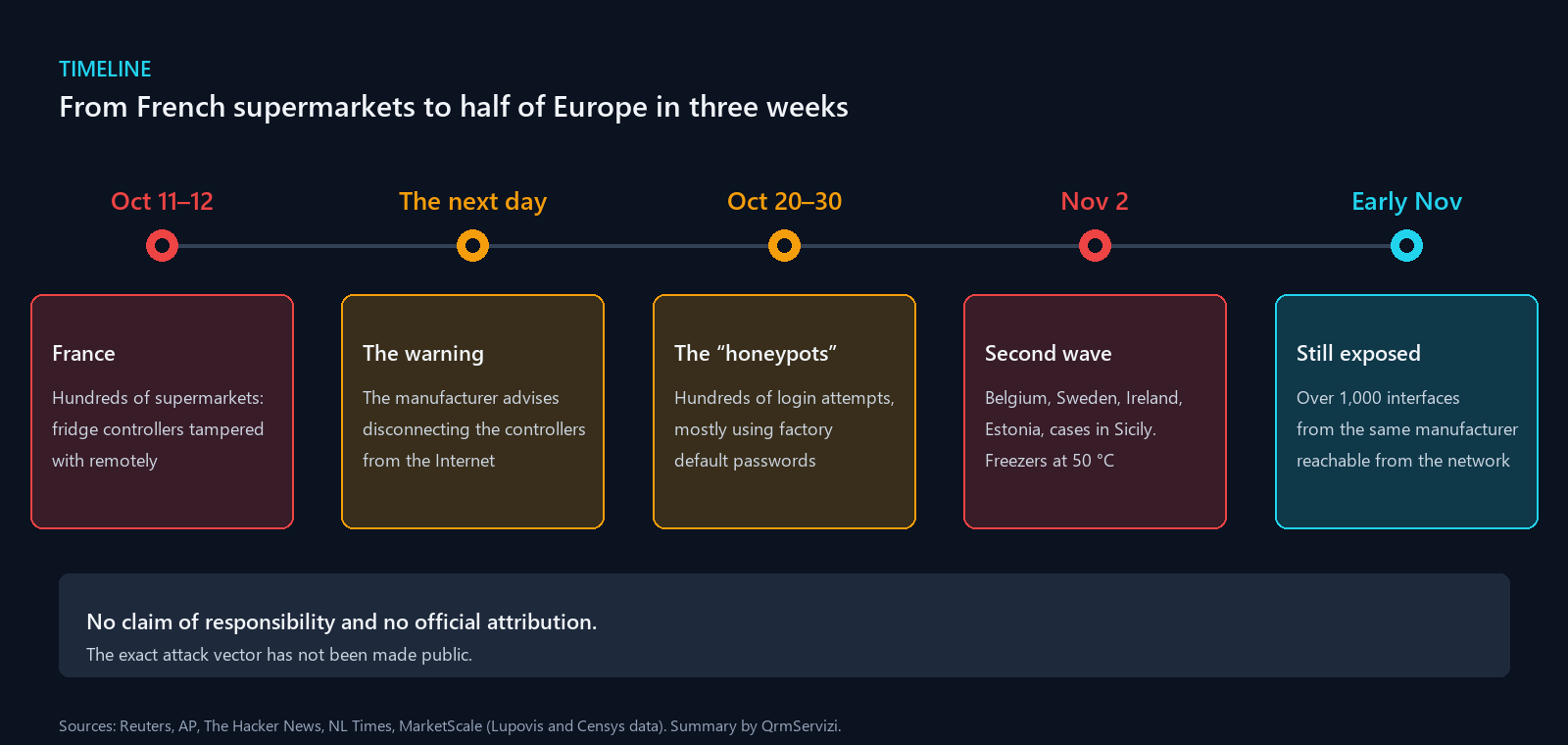
On the night of October 11–12, hundreds of French supermarkets discovered that the controllers of their refrigeration systems had been tampered with remotely: temperatures out of control, food to be thrown away, and in some cases even fires. Three weeks later, on the night of November 2, the pattern repeated itself in several European countries, from Belgium to Sweden and from Ireland to Estonia, with reports also coming from some stores in Sicily. In one Swedish supermarket, the freezers reached 50 degrees, and the anomaly was noticed only hours later.
No one has claimed responsibility for the attacks and, for now, the authorities have indicated neither who is behind them nor what the precise point of entry was. What we do know, however, is already enough to make us reflect on an issue that also concerns our own homes.
Why so little was enough
The devices involved are control units that regulate the temperature of refrigerated display cases, connected to the Internet to allow remote monitoring and maintenance. The manufacturer, Danfoss, stated that many of the affected models were old and no longer updated; in the Netherlands, it explained that the systems attacked were not on a protected network and were still using factory passwords. The day after the French attack, it had advised customers to disconnect them from the Internet: most did so, some did not, and it was precisely the latter that were hit.
The head of the UK’s National Cyber Security Centre described the French fridges as connected directly to the Internet with default passwords. A security company that put “honeypot” controllers online recorded hundreds of access attempts in the period October 20–30 alone, mostly using well-known factory credentials. In early November, according to Censys, more than a thousand interfaces from the same manufacturer were still reachable from the public Internet.
A caveat, in all honesty: no authority has published the exact attack vector, and no specific vulnerability has been officially linked to the attacks. Researchers had already demonstrated flaws in controllers from the same product family and the manufacturer had released an update, but this does not prove that those particular flaws were exploited.
The sentiment: alarm at the top, frustration on the ground
I have read the coverage of the past two weeks. It is not a survey, but a few tones clearly recur:
- Institutional alarm. A European Commissioner spoke of a deliberate attempt to disrupt the food supply chain, and the Belgian cybersecurity center said it was concerned by the growing number of incidents. In the background lies the fear of hybrid threats to infrastructure after 2022. Moscow has repeatedly denied involvement in acts of sabotage, and so far no attribution has been established.
- Technical frustration. For several experts, there is nothing sophisticated here: exposed devices, end-of-life firmware, factory passwords. One of them called it technical debt coming due. Opinions differ on the role of artificial intelligence: a Belgian spokesperson fears it makes these weaknesses easier to exploit, while other observers point out that in these cases there is no evidence it was used.
- Real fear among those on the front line. A Belgian butcher lost around €15,000 worth of meat and said he was frightened by the idea that a temperature-logging system could be reprogrammed remotely.
- Consumer anxiety, played down by experts. Concern about connected appliances is growing, but the specialists interviewed by the press point out that individual households are unlikely to be specifically targeted. The real risk is a flaw shared by millions of identical devices.
Not just fridges: the phone we don’t update
The same pattern emerges in another story from recent weeks. The company Sekoia attributed, with medium-to-high confidence, a spying campaign against Android and iOS smartphones, delivered through compromised legitimate websites, to the APT29 group (linked to the Russian intelligence services). The most instructive detail: the vulnerabilities exploited had already been fixed by the manufacturers before the campaign began. The devices hit were those that had not been updated. On November 4, the US agency CISA added one of those flaws to its catalog of actively exploited vulnerabilities.
The ethical dimension: whose responsibility is it?
When a fridge stops working because of an attack, the damage does not stay with the owner of the device: it falls on customers, employees, the supply chain and sometimes collective trust. It is a classic externality, and that is why the question “whose fault is it?” is the wrong one. It is better to ask who could have reduced the risk, and at what cost.
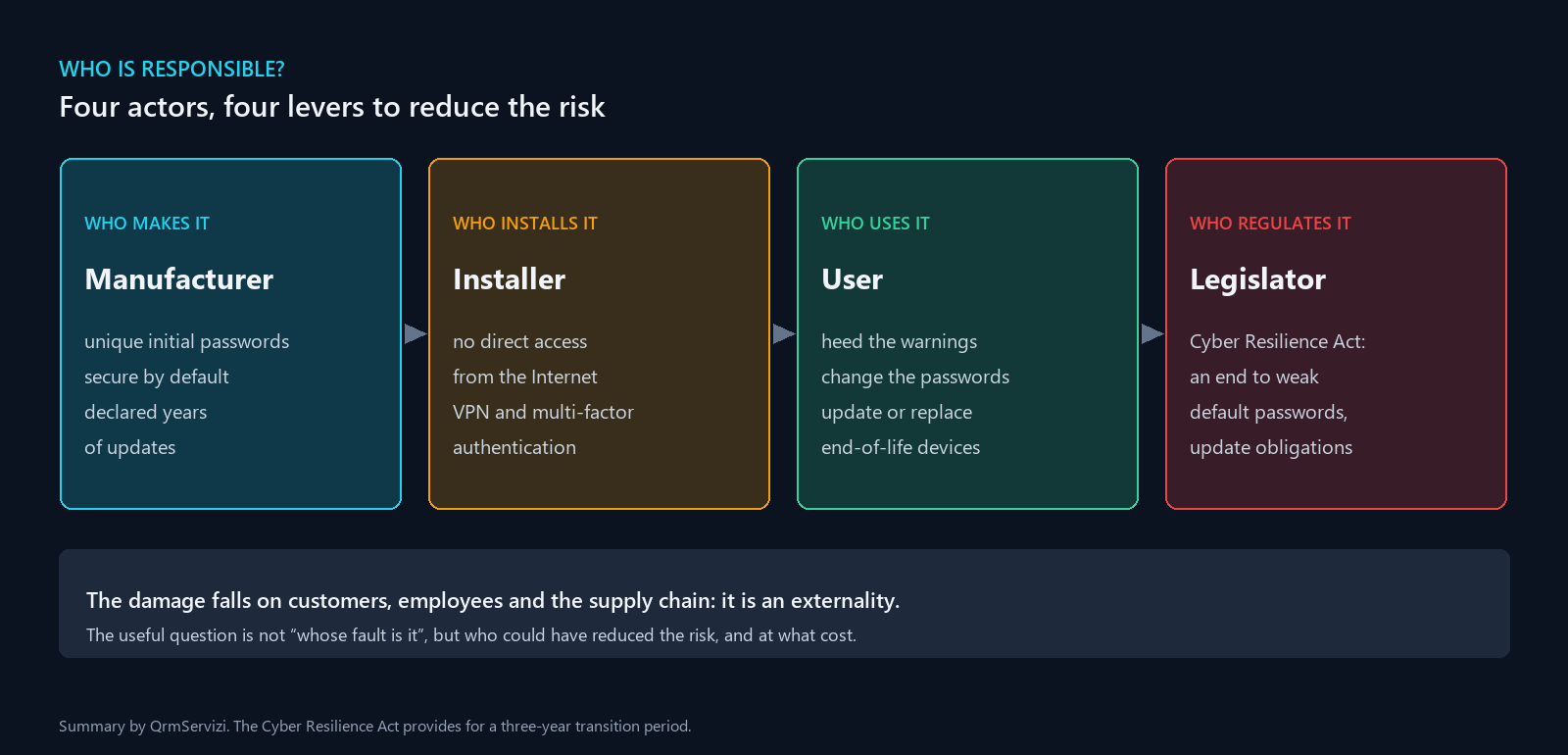
- Manufacturers decide on initial passwords, default security settings and how long a product receives updates. Selling a connected device without stating how long it will be supported is a form of opacity.
- Installers and maintainers choose how remote access works: directly from the Internet, or behind a VPN and multi-factor authentication.
- Users have a duty to heed warnings, like the one issued after the French attack, but often lack the skills or the bargaining power to verify.
- Regulators can shift the burden onto those who place the product on the market. In Europe, this is the direction taken by the Cyber Resilience Act, which provides, among other things, for a ban on weak default passwords and update obligations for products with digital elements, with a three-year transition period.
A connected device is not just an object we buy: it is a promise of maintenance that someone has to keep over time.
What to do, in practice
For those who manage facilities and businesses:
- take an inventory of devices connected to the Internet and ask, for each one, whether it really needs to be;
- remove controllers from the public network and allow remote access only via a VPN with multi-factor authentication;
- change factory passwords, update firmware and replace units that are no longer supported.
For those with a “smart” home:
- change default passwords and enable two-factor authentication where available;
- install updates, including those for your phone and browser, without putting them off;
- replace devices that no longer receive updates and keep the most vulnerable ones on a separate network (for example, the guest network);
- before buying, check how many years the manufacturer guarantees security updates for.
In short
The current waves of attacks say less about the brilliance of the attackers than about the fragility of what we have connected without taking care of it. The technology to protect ourselves largely exists already: updates, unique passwords, separate networks. What is often missing is the shared responsibility to apply it. As long as security remains a cost offloaded onto someone else, we will keep discovering its price at two in the morning, in front of a freezer at 50 degrees.
Sources consulted
- Reuters (via News Tribune), New cyberattack on supermarket fridges sweeps across Europe, November 3, 2026
- The Hacker News, second wave of attacks and French attack
- AP (via Korea Times), European supermarket fridges got hacked. Again
- MarketScale, Lupovis and Censys data; OCCRP, Hackers turn French supermarket refrigerators into furnaces
- NL Times, Danfoss statements on the Netherlands; MeteoraWeb, cases in Sicily
- CBS News, Could they hack our homes?; Cybernews, Could hackers get inside my fridge?
- BGNES (on a Sekoia report), APT29 campaign targeting smartphones


Leave a Reply